In The Adventures of Priscilla, Queen of the Desert (1994), Bernadette reflects in reference to rural Australia: “It’s funny. We all sit around mindlessly slagging off that vile stink-hole of a city. But in its own strange way, it takes care of us. I don’t know if that ugly wall of suburbia’s been put there to stop them getting in, or us getting out.”
It’s a line that captures a tension many LGBTQ+ people recognise: the push and pull between place, identity, and belonging.
Rural and regional towns are often framed as inherently hostile to LGBTQ+ lives. I’ve heard countless stories of queer people being told, sometimes even by medical professionals, that if they want to live fully and safely, they need to move to the city. And it’s true that experiences of hostility persist.
The 2025 wave of the Australian Regional Rainbow Survey found that around 54% of LGBTQ+ people in rural New South Wales reported discrimination from strangers in their community, while 25% experienced discrimination when accessing health services.
Yes—rural and regional towns can be conservative. Yes—they can foster prejudice. BUT they can also be places of deep connection, recognition, and affirmation.
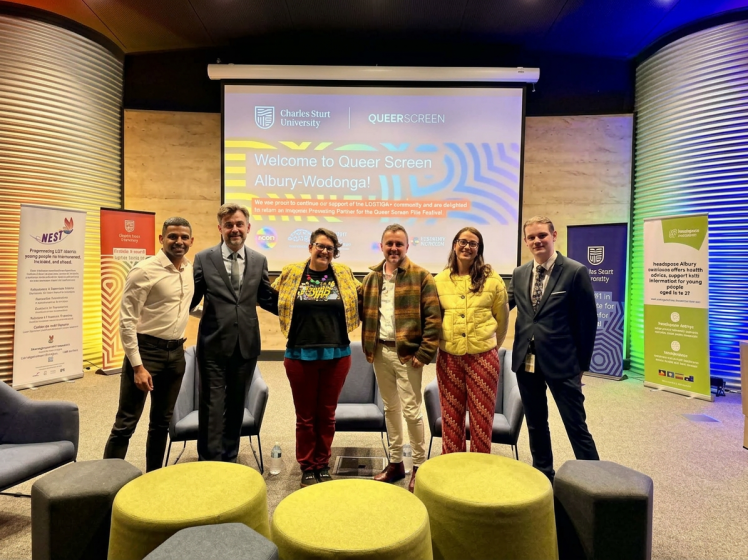
I was invited to host the Queer Screen panel discussion at Charles Sturt’s Albury campus and was struck by how the panelists spoke about moving from cities to the twin towns of Albury–Wodonga, a region of around 100,000 people. Their stories challenged that familiar narrative of displacement. In cities, LGBTQ+ people can find anonymity, but also feel a strong sense of invisibility. In rural and regional contexts, however, my research suggests something different: within the right spaces, people often feel more seen, more acknowledged.
I’ll admit, I approached hosting the panel with some apprehension. Following the recent election of a One Nation (a far right party) candidate in the federal seat of Farrer where Albury is located, I wondered how the evening might unfold. Would there be hostility? Disruption? Instead, what we saw was the opposite: a large and engaged audience, a strong sense of allyship, and a clear demonstration of the support that exists in these communities.
This is why representation mattersnot just of struggle, but of possibility.
If we only ever talk about rural spaces as unsafe or exclusionary, we risk reinforcing a narrative that silences people before they even begin. I’ve spoken to LGBTQ+ young people in rural/regional towns who believe there are no queer communities where they live—but they haven’t looked, because they don’t expect them to exist. I have also heard of many stories of LGBTQ+ people thriving in these communities!
For rural and regional communities, the challenge is twofold. We must continue to confront and challenge the prejudice that persists. But we must also actively celebrate and make visible the inclusion that is already growing.
Because belonging is not just about where you go. It’s about what you’re able to imagine is possible where you are.

