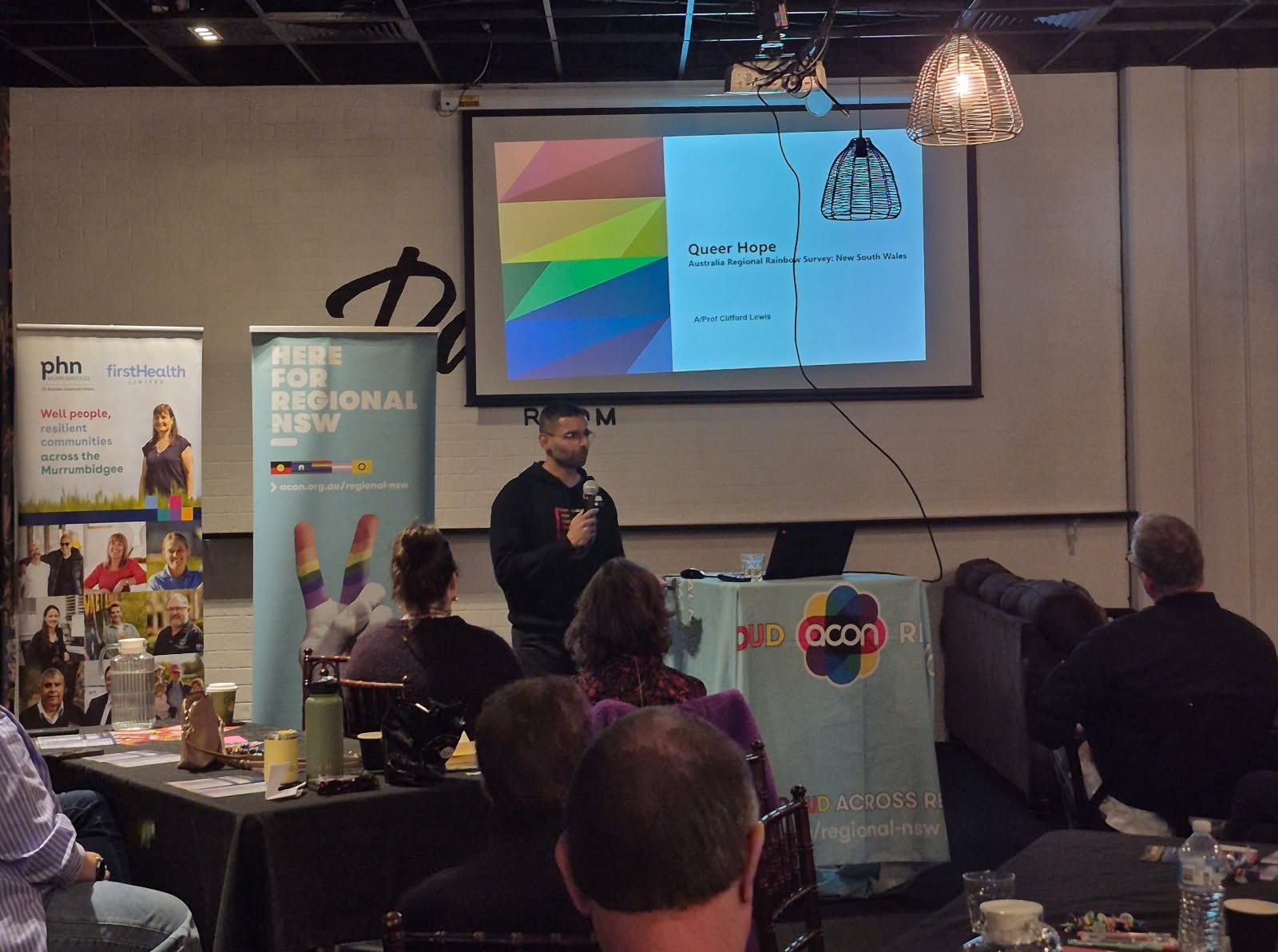
Recently I was invited by ACON to speak at the NSW Regional Rainbow Forum about my research on LGBTQ+ inclusion in rural/regional Australia.
LGBTQ+ people living in rural and regional Australia experience unique, and often significant, forms of prejudice compared to those in our capital cities. It’s perhaps unsurprising, then, that they also report lower levels of belonging and psychological wellbeing.
Yes, we need to do something about the prejudice LGBTQ+ people experience outside our major cities. But what should that “something” actually look like?
A dual approach: confronting prejudice, building visible inclusion
Effective activism here needs to take a dual approach. On one hand, we have to confront social and systemic prejudice head-on. On the other, we need to concurrently create inclusive spaces through visible signs of inclusion, things like rainbow stickers on shop windows or pronoun badges on staff, that signal a place is safe.
My own research shows that these signs of inclusion are not what people expect against the backdrop of heteronormativity and hostility often associated with rural communities. That’s precisely what makes them powerful: because they stand out against expectation, they are more readily recognised as genuine markers of safety.
But what happens to how people see themselves?
Challenging prejudice and building inclusive signs and symbols matters. On their own, though, they can’t make someone feel safe if that person has already internalised a problem with their own orientation or identity.
This is self-stigma, or what’s often called internalised homo/trans negativity: the quiet narratives we come to tell ourselves about not being good enough, simply for who we are. Any inclusion effort that doesn’t reckon with self-stigma is only doing half the job. You can put a rainbow sticker in every shop window in town, and it still won’t reach the person who has learned to see themselves as the problem. By challenging self-stigma we can work towards a world where LGBTQ+ people can make a choice to be their authentic selves no matter what environment they are put into.
Addressing self-stigma needs representation and connection
First, we need more visible representation of LGBTQ+ people thriving in the regions, and more diverse representation at that. Seeing yourself reflected back, living an ordinary, good life in the place you call home, does something that a sticker on a door cannot.
Second, we need opportunities for social connection, where LGBTQ+ people in regional and rural areas can connect with one another. That connection is where the real work of unburdening happens, collectively rather than alone.
Third, we need to challenge narratives that position rural communities as hostile and conservative. YES, this is still true in some places (as it is true of our metro cities) but there are many rural/regional communities that are accepting and embracing of their rainbow residents. I have had research participants tell me ‘there is no LGBTQ+ community in their town’ and when asked if they have looked have responded with a big fat ‘NO’. You see, the narratives of prejudice keep people in the closet and invisible.
Prejudice and self-stigma are two sides of the same coin. If we want LGBTQ+ people in regional Australia to feel safe, and to be safe, we need to keep working on both.

